

Buccal Fat & Nasal Cartilage Cushioning
Infants carry fuller cheek pads and shorter, upturned nasal bridges that make breathing during feeding easier, softly rounding sharp parental jawlines or high bridges.
Upload Dad and Mom portraits, dial the facial resemblance balance between parents, and preview shared traits from infancy through the teen years.
Face fills the frame
Looking at the camera
Encrypted processing · Uploaded photos are never shared publicly
Biological babies inherit half of their nuclear DNA from each parent, giving newborns an equal statistical chance of resembling Mom or Dad. Because infant cheek pads and soft nasal cartilage blur sharp bone angles during year one, dual-photo AI blending with a resemblance slider offers the clearest preview of shared eye spacing, smile warmth, and childhood features.
Tap which side you expect to stand out in each facial zone to see when traits appear and get a suggested studio resemblance preset.
0–12 mo: Soft epicanthal folds and wide-set eyes dominate early newborn photos. 5–8 yrs: Parental brow curve and eyelid crease clarify around ages 3 to 6.
0–12 mo: Cartilage stays flat and upturned during infancy for feeding clearance. 5–8 yrs: Bridge height and tip projection emerge steadily between ages 5 and 12.
0–12 mo: Buccal fat pads round out cheeks even when one parent has sharp cheekbones. 5–8 yrs: Cheek dimples and upper-lip curve show clearly in candid smiles after age 2.
0–12 mo: Fine lanugo or newborn hair often sheds and regrows darker or curlier. 5–8 yrs: Permanent follicle curl and melanin levels stabilize in early childhood.
0–12 mo: Newborn redness fades over the first 3 to 6 months toward true undertone. 5–8 yrs: Polygenic pigment loci blend warm, neutral, or cool undertones smoothly.
Your selected traits balance closely between both parents. Start with the 50 / 50 Blend setting in the studio above, then test Boy and Girl variations.
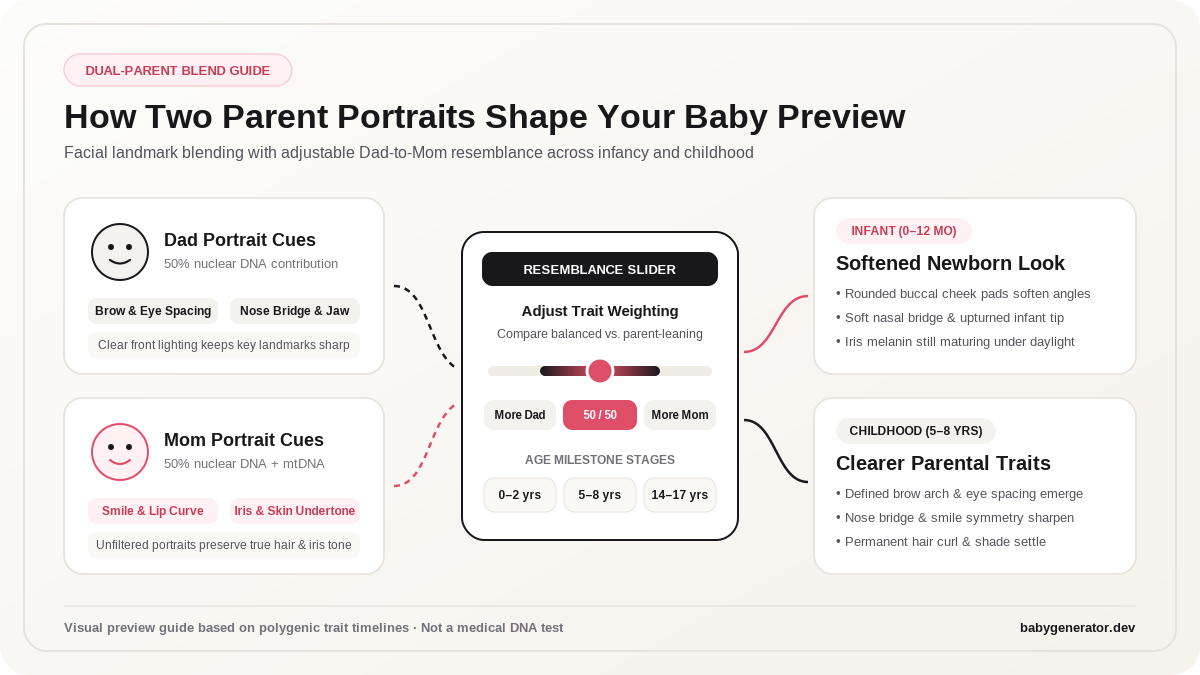
Couples asking "what would our baby look like" often expect an even half-and-half split of Mom’s eyes and Dad’s smile. In reality, facial development follows polygenic rules across hundreds of interacting genes, while newborn anatomy temporarily masks several adult landmarks under protective soft tissue.
For years, popular parenting forums repeated a 1995 claim that newborns always look more like their fathers. When cognitive psychologists Serge Brédart and Robert French later ran controlled blind photo-matching tests across 1-, 3-, and 5-year-olds, independent judges matched children equally to mothers and fathers—and recognition accuracy climbed steadily as children lost baby fat.
That developmental shift explains why our studio pairs a Feature Resemblance selector (More Dad, 50 / 50 Blend, More Mom) with three age stages. You can inspect how a soft 1-year-old portrait compares to a 6-year-old or 16-year-old version generated from the exact same parent photos.
Infants carry fuller cheek pads and shorter, upturned nasal bridges that make breathing during feeding easier, softly rounding sharp parental jawlines or high bridges.
As baby cheeks thin out and permanent teeth begin arriving, parental brow arch, inter-pupillary spacing, chin projection, and ear shape become far easier to spot.
Use the reference table below to understand which visible parent traits appear immediately in newborn portraits and which take several years of growth to clarify.
| Parental Feature | Infant Stage (0–12 Months) | Childhood Stage (5–8 Years) | Studio Resemblance Tip |
|---|---|---|---|
| Eye Spacing & Brow Arch | Wide-set, bright eyes dominate early focus; brow hair stays sparse and fine. | Upper orbital contour and brow curve mirror one or both parents closely. | Keep glasses and bangs clear of the eyebrows in both uploads. |
| Iris Pigment & Eye Color | Lower stromal melanin makes many light-skinned newborns look slate blue or gray. | True green, hazel, amber, or brown tones stabilize by 12 to 24 months. | Shoot near a bright window so natural iris color is captured accurately. |
| Nasal Bridge & Tip | Soft, low cartilage bridge with a rounded infant tip regardless of parent height. | Midface vertical growth reveals bridge slope and nostril proportions. | Preview Child (5–8 yrs) to test how a parent’s stronger bridge blends. |
| Cheek Dimples & Smile | Plump cheeks can hide subtle dimples except during wide, expressive smiles. | Lip bow curvature, tooth alignment, and zygomaticus dimples stand out. | Upload relaxed, natural smiles rather than stiff passport expressions. |
| Hair Shade & Texture | Fine newborn hair often sheds around months 2–4 and regrows darker or curlier. | Follicle shape (straight, wavy, coily) and eumelanin levels settle. | Let hair fall naturally instead of tying it tightly behind the head. |
| Jawline & Chin Contour | Rounded infant chin cushions obscure clefts or square mandibular angles. | Lower-face elongation begins showing Dad or Mom’s chin profile clearly. | Look straight at the lens without tilting your chin upward or downward. |
Instead of locking you into one rigid composite, this studio lets you test three distinct inheritance balances without re-uploading your photos.
Return to our main AI baby generator homepage for general studio runs, or browse our directory of specialized predictors and genetics tools.
Small capture habits make a dramatic difference in how faithfully any portrait model reads your features. Side-angle snapshots, heavy social filters, and overhead bar lighting distort eye spacing and wash out true skin undertones.
Before generating, pick two solo front-facing photos taken in soft daytime window light. Avoid sunglasses, hats, or group selfies with cropped faces nearby, and make sure neither photo applies smoothing beauty presets that erase natural freckles, brow texture, or lip lines.
Honesty matters when couples explore "what will our baby look like" tools online. Our studio analyzes visible photographic geometry—eye spacing, brow arch, nose width, smile shape, and lighting-adjusted undertone—to render a heartwarming, photographic keepsake. It does not sequence DNA or detect hidden recessive alleles carried from grandparents.
Because human traits like eye color, hair curl, and facial dimples involve polygenic combinations and incomplete penetrance, two brown-eyed parents carrying recessive light-eye variants can still welcome a blue- or green-eyed baby, and siblings routinely inherit noticeably different mixes of the same family traits. Treat every generated portrait as an inspired artistic preview rather than a biological certainty.
Browse our complete hub of baby prediction tools and read evidence-based genetics guides backed by NIH MedlinePlus and NHGRI references.
Our AI predictor blends visible photographic features from Dad and Mom—such as eye spacing, brow contour, nose bridge, smile curve, and skin undertone—into a studio portrait. Real genetics draws on thousands of polygenic variants and recessive alleles from both parents and grandparents, so real siblings always show natural surprises beyond any photo-based preview.
Selecting 50 / 50 Blend weights both parent portraits equally, while More Dad or More Mom tilts roughly two-thirds of the primary facial landmark influence toward the chosen parent while preserving natural traits and warmth from the other partner.
Newborns have generous buccal cheek pads, soft nasal cartilage, and immature iris melanin that can shift eye color over the first 12 to 24 months. By ages 5 to 8, facial bone proportions elongate and parental brow, nose, and smile contours become much clearer—which you can test using the Child age toggle above.
Controlled blind photo-matching studies, including Brédart and French (1999) in Evolution and Human Behavior, found no consistent bias toward fathers over mothers. Infants inherit 50% of nuclear DNA from each parent and resemble both sides at roughly equal rates.
Yes. Without re-uploading your photos, switch Gender to Twins to preview a sibling pair, or switch Photo Type to Family Photo to see Dad, Mom, and your predicted future baby smiling together in warm cream studio knitwear.
Yes. Your photos are transmitted over encrypted HTTPS solely to render your requested studio portrait, never published to any public gallery, and never used for advertising or third-party sharing.
Upload Dad and Mom portraits to preview your future boy, girl, twins, or sunlit family photo.
Browse specialized AI portrait studios alongside instant genetics, height, twin, and name calculators.
Explore research-backed explainers on inherited childhood traits, prompts, and parent photo framing.